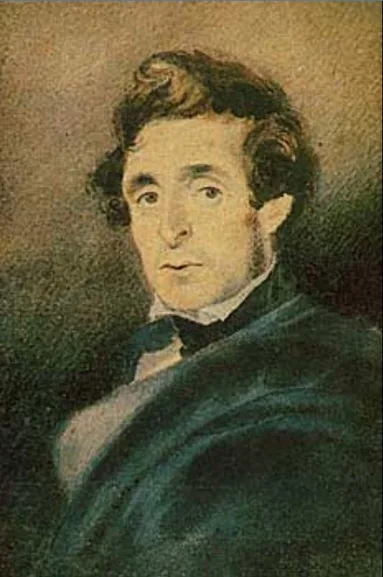

William Buelow Gould (c.1803-1853) was born in Liverpool, Merseyside, England. While little is known of his early life, it is thought that he received artistic training under Irish painter, William Mulready, in London, and German lithographer, Rudolph Ackermann, in The Strand. It is also believed that he worked in Spode’s factory in Stoke-on-Trent, Staffordshire, as a painter of porcelain.
On 7 November 1826 he was convicted in Northampton, East Midlands, of stealing a coat and was sentenced to seven years prison in Van Diemen’s Land. At the time of this conviction, Gould was married and had two children, and had also received a prior conviction for theft.
Gould was transported to Australia aboard the convict ship Asia, arriving in Hobart Town, Van Diemen’s Land, in December 1827. He was initially sent to work on the brickfields but was soon in trouble again for mainly petty offences involving theft and drunkenness.
In June 1829 Gould was sentenced for forgery of a banknote to three years at Macquarie Harbour Penal Station. During the voyage from Hobart Town to Macquarie Harbour, the brig transporting Gould became weather bound and half the convicts mutinied, taking the brig. Gould was amongst the convicts marooned with officers, and was part of the party who went overland by foot to seek help.
Lieutenant-Governor Sir George Arthur commuted the sentences of the convicts who had remained with the officers, and Gould was assigned as a house servant to the colonial surgeon Dr James Scott. An amateur naturalist, Scott put Gould’s artistic talents to use, having him paint watercolours of native flora. However, he was again sentenced to Macquarie Harbour in 1832.
Based on his reputation from his time with Scott, Gould was assigned as house servant to another amateur natural historian, Dr William de Little at the penal station on Sarah Island. Here he continued with his painting, producing highly accomplished still life watercolours of botanical specimens, birds, fishes, and other sea life collected from the surrounding beaches. His work also included landscape sketches providing important insights into the convict settlement.
When the Macquarie Harbour settlement was closed in 1833, Gould was transferred to the Port Arthur Penal Station, eventually being granted his Certificate of freedom on 25 June 1835.
He worked briefly for a coachbuilder in Launceston before returning to Hobart Town and marrying Ann Reynolds in 1836. He made a living selling paintings of flowers and still life arrangements in the style of the Dutch manner. However, he continued to drink and in 1846 was convicted of theft and sentenced to two years hard labour.
Gould died on 11 December 1853 of natural causes at his home on Macquarie Street, Hobart Town.
Stamps & Postal Products
2026 WB Gould’s Sketchbook of Fishes


