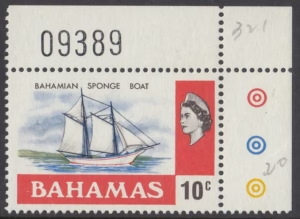
The Bahamian sponge industry appears to have been started by a Frenchman, Gustave Renouard, who was shipwrecked in the Bahamas in 1841 and who began dispatching sponges to Paris as soon as he had recovered from the ordeal. Two years later, the sun-scorched scattering of British islands exported 132 bales of the increasingly popular bath item to London stores.
At the height of the trade there were 265 schooners, 322 sloops and 2,808 dinghies in the sponging fleet. A single vessel might return with between 5,000 and 15,000 after one voyage.
In 1937, a closed season on sponge fishing was imposed, and harvesting of sponges under a certain size was forbidden. In November and December 1938, a microscopic fungus disease attacked the Bahamian sponge beds, wiping out 99 percent of sponges.
Details
- Series: 1971 Definitive Series
- Subject: Bahamian Sponge Boat
- Designer: Elyse Wasile
- Printer: Format International Security Printers Ltd
- Process: Lithography
- Paper:
- Watermark: Multiple St Edward’s Crown Block CA (upright)
- Perf: 14.5 x 14 (comb)
- Cylinders:
- 1A (Red) 1A (Blue) 1A (Yellow) 1A (Black) : 1B (Red) 1B (Blue) 1B (Yellow) 1B (Black)
- 1A (Red) 1A (Blue) 1A (Yellow) 2A (Black) : 1B (Red) 1B (Blue) 1B (Yellow) 2B (Black)
- Sheet: R10 x 10 (100 stamps)
- Quantity:
Cylinder Numbers (1st Printing)

Cylinder Numbers (Missing Printing)
Stanley Gibbons lists the 2A/2B plates being used in the 1976 printing with the new Multiple Crown CA (Diagonal) watermark. However, the 1A 1A 1A 2A cylinder below is printed on the Multiple St Edward’s Crown Block CA watermark.

Sheet Numbers (1st Printing)

Sheet Numbers (Missing Printing)